Memories
How to turn the memories of a trip into a book
A travel book is not an album with captions. It is what remains when you have taken almost everything out.
The Traveller Journal6 min read
In this article
Turning a trip into something you can read again does not start with design. It starts with throwing things out.
Most trips produce more material than anyone wants to go through: bursts of photos, tickets, screenshots, messages, a half-written note. A book — even one that for now only lives on a screen — is the result of keeping one version. Not the complete archive.
Today that version can be opened. It cannot be ordered in print. It is worth not mixing the two up.
What goes in, and what stays out
What goes in is what you could not get back with a search:
- A city where you slept, not every place you passed
- A few photos, the ones that still name someone or an hour
- A note only you could have written
- A specific place: a bakery, a viewpoint, a stop
- Sometimes a voice or a song, if it really brings the day back
What stays out:
- The full burst
- The hour-by-hour itinerary, except a journey that changed the trip
- General opinions about a country
- What you kept just in case and have not opened since
- Anything that needs an apology to be there
If you hesitate, leave it out. A short book gets read. A complete one gets postponed.
Cutting the photos down has its own method in how to organise your travel photos. Do not redo it here with a second standard. By the time you reach the story, the pile should already be small.
An order you can follow
The clearest order is usually the order of the days, but not of every hour. Short chapters, one per city or per stretch.
Inside each chapter, a similar rhythm helps you read:
- Where you were and when, in one line.
- One image, or none.
- What happened that is not in the image.
- The detail you would want to repeat: an address, an hour, a name.
It does not have to be the same shape every time. A day on the move can be just the train. A full day can be three lines. The regularity is that each chapter opens on the place, not on a mood.
If the trip was a single city, the chapters can be neighbourhoods or days, not "introduction, development and ending". A trip is not a report. If it was many cities in a short time, join the ones that were only a night. A three-line chapter is better than inflating a layover until it looks like a stay.
The selection is the tone
Two trips to the same city produce different books depending on what you leave in. One can be food and neighbourhoods. Another can be a museum and a missed train. Both are faithful if you do not also try to fit in everything else "so it is complete".
Complete is the archive. Readable is the selection.
Read aloud what you have kept. Where you get bored, cut. Where you would not understand a sentence in a year — "the usual thing at that place" — add the name or take it out. The future you does not share your context. They only share the book.
The feed will not keep this for you next winter. A page with the name of the city will.
The book you can open now
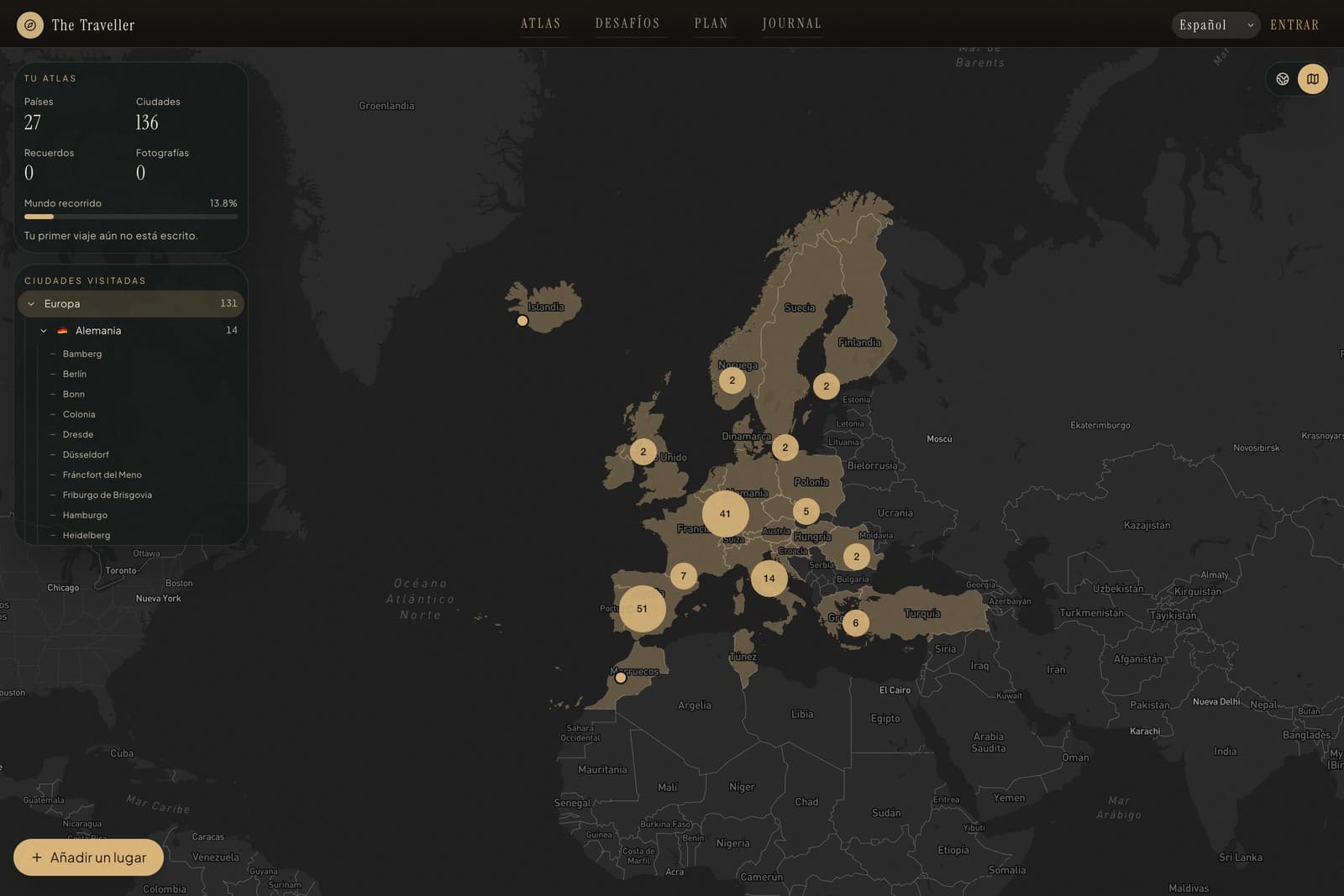
That book, right now, is the map.
Each city on the Atlas can hold what you chose: photographs, a note, a short video, a voice, a song, a specific place. You open the city the way you open a chapter. If the trip jumped from one city to another, the pages are already in geographical order, which on most trips is also the order of the days.
Nothing has to be laid out for that to exist. You have to have chosen. An empty pin is an index. A pin with three photos and a sentence is a page.
The plan, if there was one, stays where it is for trains, beds and bookings. It is not the book. The book is what you want to reread, not what you needed in order to arrive.
A book in paper — a cover, a printer, an object for a shelf — is a possible direction, not an order you can place today. Until it really exists, promising it would be turning a page that is not there yet. What you can open tonight is the city.
One trip, not a whole life
The temptation, once the method works, is to put every trip into the same book. It almost never gets read. One trip, a country you keep going back to, or a year if it really forms a story: pick a size and finish that one.
Mixing ten years into a single account forces so much summary that the streets disappear. Leave them as separate books, even if one of them is only six pages. Six pages of a specific city get opened. Sixty pages of "my travels" get flipped through and closed.
If you want to join them later, you can. It is easier to join two short accounts than to split one that tried to say everything.
Show it only if you want to
A trip can stay private and still be whole. Publishing it does not improve it.
If at some point you want someone else to see it, you can decide what is visible and what is not: the map, the cities, the memories, other parts of your page. Your email does not go into that. And you can leave it off. A book only you read is still a book.
To get there, what is sometimes missing is the habit of noting little, and in time. A digital journal fits in a sentence a day. And if the skeleton does not even have the cities, the record of where you have been is the first page: not the list of countries, but the places where the trip happened.
Keep travelling

Memories
How to keep a digital travel journal
A travel journal works when it keeps little, keeps it in time, and keeps it where it happened.
Memories
How to organise photos from all your trips
A camera roll sorts by the hour. A trip is found again by city, and by the few photos that still say something.
Memories
How to keep a record of every country you have visited
Counting countries is a shortcut. The map you later want to open is made of cities, not boxes.