Memories
How to keep a digital travel journal
A travel journal works when it keeps little, keeps it in time, and keeps it where it happened.
The Traveller Journal7 min read

In this article
The journal you do not write is the one you promised to fill every night. The one that exists is usually shorter: a sentence on a platform, a photo of a table, the name of a song, four lines when you get back to the room.
Digital does not change that rule. It only stops the notebook staying at home, and stops you, two years later, from wondering whether that note was Lisbon or some other city with hills.
What is worth keeping
Do not keep the whole day. Keep what you will not be able to rebuild from a guidebook.
An entry is worth it for:
- A conversation, even three sentences
- What you ate and where, if the place has no reason to still exist
- The weather as it actually was, not as forecast
- A mistake: the train, the street, the plan you changed
- A person's name, written while you still have it right
- An address or a neighbourhood, with a reason
- What you heard: a song, a market, an odd silence
It is not worth an entry, unless it amuses you:
- An hour-by-hour account
- The list of monuments that already lives everywhere
- A general opinion about "the people" or "the food" of a whole country
- The attempt to sound good
One concrete line ages better than a pretty paragraph. "The café on the corner opens earlier than ours and the owner does not talk" is still useful in ten years. "A magical morning in the little streets" tells you nothing, including you.
When to do it
Three moments work. Pick one and drop the others without guilt.
In the moment. Thirty seconds. The name of the place, a photo, a voice note while you walk. This is for what disappears in an hour: the name of the street, what was playing.
At the end of the day. Five minutes, not thirty. Three sentences. If you only have one, that is the entry. The bathroom or the bed beats "later, properly", because later is already another day.
When you are home. One sitting per trip, not per day. This is for sorting, not for remembering detail. Details you did not note there will have gone generic. Do not invent them to fill the gap.
The worst system is the one that demands all three. The journal becomes a task and gets dropped. A poor system you use is better than a complete one you abandon on day four.
How not to turn it into a chore
The journal has no audience. If you write for whoever might read it, you start cutting the small things and keeping what sounds like a proper trip. That is exactly what you will not need later. The small things are already gone.
A few rules that lighten it:
- An entry can be a single sentence.
- You can skip days.
- A note does not need a photo, and a photo does not need a note.
- Nobody has to see it. Showing it is a later decision.
- If it bores you, shorten it. Do not turn it into a project.
You also do not need a different app for each thing. A note, a photo, a voice and a song can live together if they are tied to the place. If they sit in separate folders — audio here, images there, text somewhere else — you will not gather them in a year.
Examples of small entries
None of these is from a specific trip. They are the right size.
A note. "Tuesday. Rain, and the museum is closed on Mondays, which was yesterday. We stay in the café on the square until it clears. The waiter lets us use the socket without being asked."
A place. "Bakery on the market street, the second one, not the corner. The pastry comes out at nine. There is a queue and it is worth it."
A voice note. Twenty seconds leaving a station: the platform, that the village was smaller than the map suggested, and that the bus back is at six, not seven.
A song. The one that was playing in the bar, or in the car. No explanation, or just one: "they played it twice and nobody left."
A photo with a line. Not the monument. The table afterwards, the light in the room, the boots by the door. The line says what had happened an hour before.
Nothing. A blank day because you were fine and there was nothing to fix in place. That counts too.
Photos, voice, music and places
Each format keeps a different thing. Using all of them every day is another chore. Use the one that fits.
- The note keeps the context a photo cannot.
- The photo keeps a light and a face. Few of them. The way not to keep the whole camera roll is in how to organise travel photos.
- A short video keeps a gesture: a market, a platform, someone talking. Not the day filmed from start to finish.
- Voice keeps the tone when you do not feel like writing. It also keeps names you would spell wrong.
- A song keeps the feel of a place better than an adjective.
- A place — a point inside the city — keeps where to go back, or where not to.
If you could keep only two, keep the short note and the place. The rest can be added when there is time.
Where to leave it so you can return
A loose note on the phone mixes with the shopping list. A journal that lives in the city opens the way a book opens: at the page, not on the date you remembered to sync.
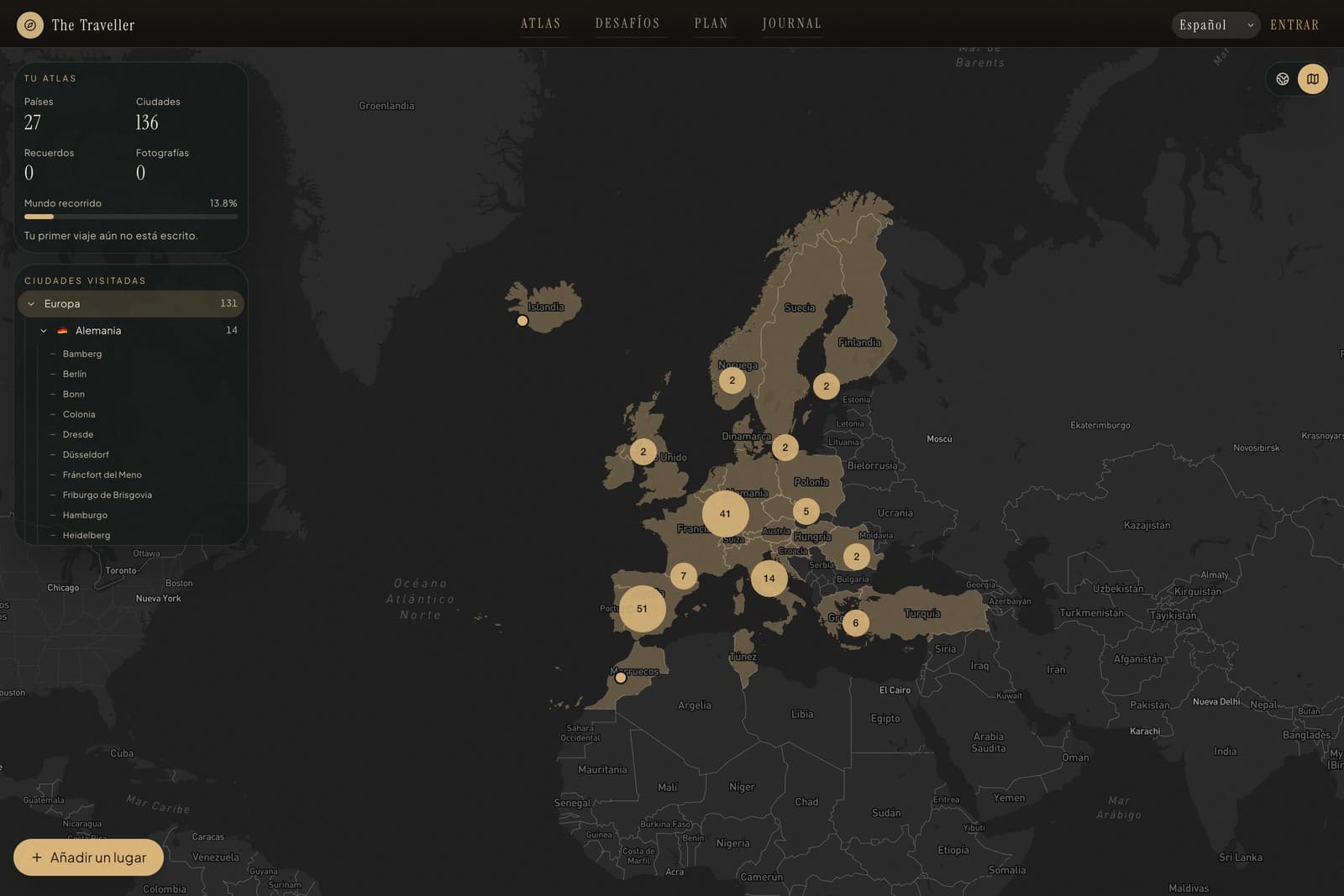
On the Atlas, the memory is kept in the city. It can be a note — a title, a few lines, a date, tags — a handful of photos with a caption if you need one, a short video, a voice, a song, or a specific place inside that city, with its map. You do not have to fill every type. You need, when you touch the city, to find what was yours.
That is different from a folder called "trip". A folder sorts files. A city sorts memory.
The journal is not for an audience. It is for the person you will be in ten years, looking for a smell and a name.
When several cities from the same trip have even one line, you can already read it straight through. How to shape those memories is about what to leave out and how to order the rest. And if what you want first is to know which cities were on the map, the record of countries and cities starts there, without asking you to write every night.
Keep travelling

Memories
How to organise photos from all your trips
A camera roll sorts by the hour. A trip is found again by city, and by the few photos that still say something.

Memories
How to turn the memories of a trip into a book
A travel book is not an album with captions. It is what remains when you have taken almost everything out.
Memories
How to keep a record of every country you have visited
Counting countries is a shortcut. The map you later want to open is made of cities, not boxes.