Memories
How to organise photos from all your trips
A camera roll sorts by the hour. A trip is found again by city, and by the few photos that still say something.
The Traveller Journal7 min read
In this article
Organising the photos of a trip is not backing all of them up. It is deciding which ones still say something when you no longer remember the day you took them.
The method on this page works with the phone's camera roll, a folder on a computer, or boxes of pictures from years ago. It does not depend on an app. At the end, if you want, those few photos can live in the city they belong to.
Start by throwing out, not by sorting
Sorting a thousand photos is a way of not looking at them. The first move is to keep fewer.
Make three piles, even if they are virtual:
- Yes. You would recognise it in five years without reading the date.
- Maybe. It has someone in it, or a light, but another one almost the same is better.
- No. It is dark, repeated, cut off, or it was a reminder ("the bus number") that has already done its job.
Delete the third pile, or take it out of the trip folder. Do not archive it "just in case" next to the good ones. Just in case is why nobody opens the album.
From the maybe pile, keep one of each burst. The whole burst is not a memory. It is the moment before you decided the frame.
A rough figure, not a law: from a day, between five and twenty photos. From a week, what fits in a ten-minute sitting. If you need an hour to look through them, you have not thrown out enough.
What makes a photo worth keeping
It is not the sharpest one. It is the one that answers one of these:
- Who was there?
- What was the weather actually like?
- Where did we eat, sleep or get lost?
- What would not be in a guidebook?
The well-framed monument can stay, once. The table afterwards, the unmade bed, the bus stop in the rain often say more about the trip. You do not need to make that poetic. You need not to keep only what a million other people already have.
If a photo needs a paragraph to be understood and you do not feel like writing it, it may not be one you keep. Or it may be exactly one that needs a line. That is already a journal: how to write those lines without turning them into a duty.
Give them a place
The date alone is not enough. "2019" can be three trips. The place is what lets you go back in.
Work trip by trip, and inside the trip, city by city. Not by month. The same month can hold a weekend in a capital and a week somewhere else.
For each group, the name should say the place, not the device. "Rome, October" beats "IMG_4412" and also beats "Italy trip final FINAL". If there were several cities, do not mix them in a folder named for the country. The country is too big. The city is the drawer you later know how to open.
Photos with no place are not lost, but you have to decide by hand. If you do not remember where they were, do not invent a city so the archive looks clean. Leave them in a "no place" group, or delete them if they say nothing either.
Dates you can read
The camera usually stores the date in the file. Even so, the folder name should carry the year, and the month if you travel often. Inside, do not rename every file. Rename the group.
If you go to the same city in different years, do not merge them. "Lisbon 2016" and "Lisbon 2024" are two trips. Putting them together lets the second erase the first.
Check the time zone. Sometimes the first photo of the day appears on the day before. You do not need to correct every minute. You do need the arrival day not to mix with the flight if that confuses you when you search.
Favourites
A favourite is not the prettiest photo to show. It is the one that opens the trip.
Mark very few: one a day, or one a city if the day did not give you more. A heart on everything is the same as no heart.
Those few are what you will look at when someone asks what it was like. The rest is the archive. Both can exist. They do not have to live in the same view.
Copies
One copy on the phone is not a copy. It is a hope.
Keep at least two different places, and let one of them not depend on the phone staying whole:
- The phone or the computer where you work
- A drive or a cloud you actually open now and then, not only the day you pay for it
The cloud counts if you know how to get in and if what you keep fits. A drive counts if you plug it in sometimes. Choose the system you already use. The best new system, abandoned after two weeks, is worse than a boring folder you do copy.
You do not need to duplicate the rejects. Copy what survived the first cut. Then the backup is readable too.
From folders to cities
When a trip is already reduced to its good photos, grouped by city with a year in the name, the hard work is done. The tool does not matter. You can leave it there.
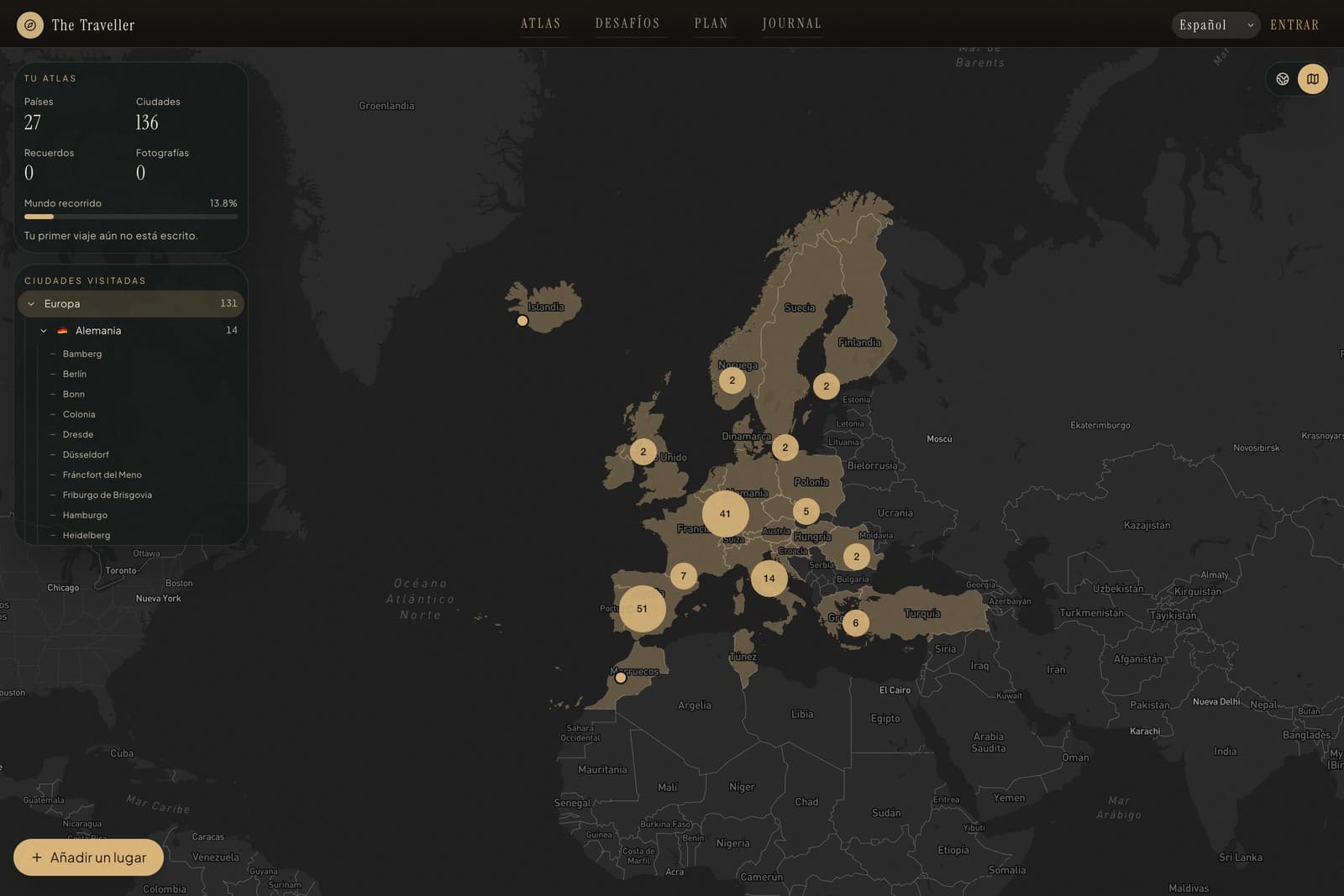
If you want opening a city to show those photos — and not the whole country in a flat album — the Atlas works that way: a photo memory is added to the city. A few are enough. A short video fits in the same place if the gesture matters more than the frame.
There are two ways to bring places in, and neither guesses the picture. From photos on this device, the place still stored in the file is read. Photos that do not carry it stay out. You can also use a Google Maps history file. Google Photos is not connected.
Keep the cities that feel like yours. A layover does not have to go in. The way to tell a visit from a mere passing-through is in the record of countries and cities.
Editing is a way of remembering. What you keep is the trip. What you leave in the camera roll is the noise.
Those cities, with their few pictures and a line if you have one, can already be read as chapters. How to turn that material into a story does not ask for more photos. It asks you to choose where it starts and what stays out.
Keep travelling
Memories
How to keep a digital travel journal
A travel journal works when it keeps little, keeps it in time, and keeps it where it happened.

Memories
How to turn the memories of a trip into a book
A travel book is not an album with captions. It is what remains when you have taken almost everything out.
Memories
How to keep a record of every country you have visited
Counting countries is a shortcut. The map you later want to open is made of cities, not boxes.